
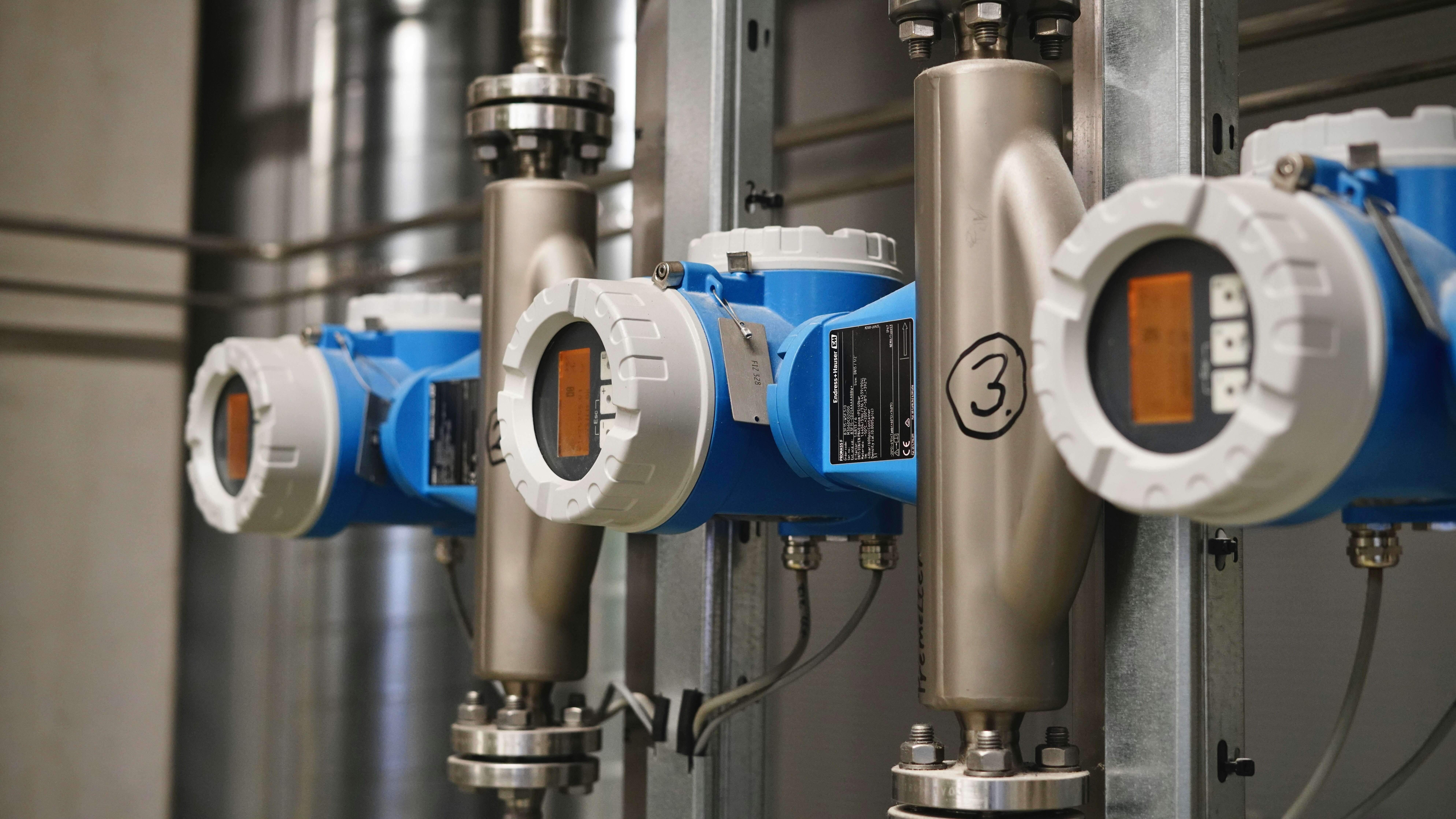
In the field of flow measurement, a variety of technologies are available to meet the specific needs of industrial applications. Two commonly used technologies are:
- ultrasonic flow measurement
- magnetic flow measurement
In short: Which technology should you choose?
- The electromagnetic flowmeter: This is the choice for durability and accuracy for all conductive liquids (water, acids, slurries). However, it requires cutting into the piping for installation.
- The ultrasonic flow meter: The solution for flexibility. Thanks to its external (clamp-on) sensors, it can be installed without interrupting your production. Ideal for non-conductive fluids (oils, hydrocarbons) or retrofitting existing systems.
Ultrasonic technology: the flexibility of the "clamp-on" mounting
Choosing between these two methods can be crucial to ensuring accurate and reliable measurements. In this article, we’ll explore the features, advantages, and disadvantages of each technology to help you make the right decision.
In the field of industrial ultrasonic flow measurement, we often encounter #Flexim #Emerson, a pioneer in the manufacture, implementation, and installation of this type of equipment. Their #Fluxus system determines flow rate using the differential transit time measurement method.
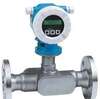
When it comes to magnetic flow measurement, there are various companies such as #Endress + #Hauser with its #Prosonic series and #Krohne with its #Optiflux series. Value for money is a key factor, which is why this type of technology is very often chosen.
Spotlight on Ultrasound Technology: The Flexibility of Non-Invasive Methods
Ultrasonic flow measurement is based on the principle of emitting high-frequency sound waves through a fluid to measure the fluid’s velocity and calculate the flow rate. There are two measurement methods: transit time and the Doppler effect.
The transit time method (clean fluids)
The principle involves placing two ultrasonic sensors on either side of the pipe. They send ultrasonic pulses in both directions:
Sound travels faster in the direction of the flow than in the opposite direction, so:
The time difference allows us to calculate the fluid's velocity.
The Doppler effect method (charged fluids)
The principle involves sending an ultrasonic wave into the fluid. If solid particles or bubbles are present, they reflect the wave.
Since these particles move with the fluid, the frequency of the reflected signal changes, making it possible to determine the fluid's velocity.
Not sure which technology is right for your process?
Don’t let an instrumentation error slow down your commissioning process. Our ING&DEM experts will help you assess your needs to ensure accurate measurements right from the design phase.
The electromagnetic flowmeter: precision for conductive fluids
Magnetic flow measurement is based on Faraday's law, which establishes a relationship between the fluid velocity and the electromotive force induced by a magnetic field.
We believe that when a conductive liquid passes through a magnetic field, it generates a voltage proportional to its velocity. This technology is primarily used with conductive liquids (minimum ≈ 5 µS/cm).
Comparison: Which Technology Is Best for Which Industrial Application?
Conductive liquid
Measurement method: Faraday's law
Accuracy: Good
Essential application: Water
Benefits:
- Very sturdy
- Low pressure drop
- Use with dirty liquids
- Used for commercial transactions
Clean liquid
Measurement method: Transit time
Note: Depending on the amount of fluid
A must-see: Large pipelines
Benefits:
- Non-intrusive
- Clean fluids
- No pressure drop
- Ideal for retrofitting
- Installation without drilling into the pipe
Clean liquid with low particle content
Measurement method: Doppler effect
Note: Depending on the fluid's quality
A must-see: Large pipelines
Benefits:
- Non-intrusive
- Fluids containing particles
Case Studies: ING&DEM's Expertise in Real-World Situations
For example, at a #SEVESO II facility, we worked with our client to select a #Fluxus flowmeter from #EMERSON #Flexim to measure the flow rate in its #DICHLORETHANE (DCE) pipeline during the retrofit of the facility.
Another example: as part of the process to bring discharge standards into compliance following inspections by the DREAL at another client’s site, we proposed the installation of a #Krohne #Optiflux 2300 flowmeter using the “virtual reference” calibration method in accordance with the #OIML R49 commercial transactions (TC) certificate.
Conclusion: Independent advice for your instrumentation
In conclusion, the choice between ultrasonic flow measurement and magnetic flow measurement will depend on the specific requirements of your application, the nature of the fluid being measured, and operational constraints.
As we are independent of equipment manufacturers, we invite you to consult with us to make the best possible choice based on an optimal measurement quality-to-price ratio tailored to your needs.