


The HART (Highway Addressable Remote Transducer) protocol has played a crucial role in the evolution of industrial communication technologies since its introduction in the 1980s. Designed to improve communication between measurement instruments and control systems, HART has been widely adopted for its effectiveness in industrial environments. This article examines the future of the HART protocol, exploring its current strengths, challenges, and potential developments that could influence its role in the industry.
In brief
- The existing infrastructure is holding its own: Despite its speed limitations, HART remains the go-to solution for modernization without incurring the astronomical costs of a complete rewiring.
- Safety first: While 5G and wireless technology are becoming the norm for monitoring and maintenance, traditional wiring remains the standard for critical safety loops (SIL, emergency stops).
- A transition through "small steps": Developments such as HART 7 and HART-IP make it possible to bridge the gap to the IIoT in a gradual and cost-effective manner.
The Origins and Strengths of the HART Standard in Instrumentation
How the Hart protocol works
The HART protocol was developed to enable two-way communication between field instruments and control systems. It uses frequency modulation to superimpose digital information onto 4–20 mA analog signals, allowing data communication to occur simultaneously with process measurements.
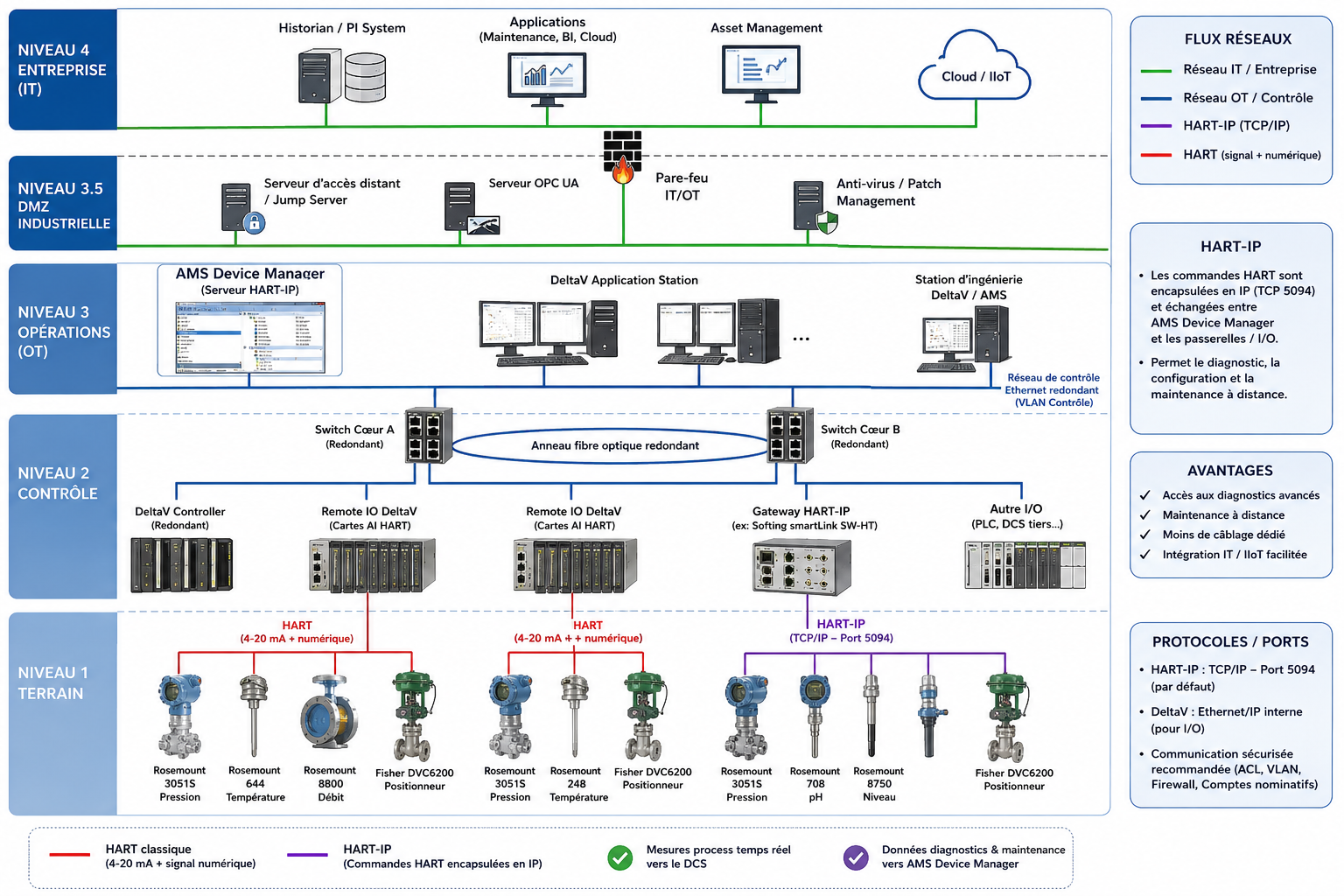
Remote configuration and diagnostics: the operational benefits of the protocol
- Compatibility with Existing Systems: HART is compatible with older control systems that use analog signals. This has facilitated its adoption in many industrial environments without requiring comprehensive upgrades.
- Two-Way Communication: The protocol not only enables the transmission of measurement data but also allows for remote configuration and diagnostics of instruments, thereby improving operational efficiency and reducing the need for on-site maintenance.
- Monitoring and Diagnostics: HART provides monitoring and diagnostic capabilities that allow users to verify instrument performance and detect issues before they become critical.
Technical Challenges in Modern Network Architectures
Speed and bandwidth limits in the face of competition
Although HART was innovative in its day, its bandwidth and communication speed capabilities are limited compared to newer protocols such as FOUNDATION Fieldbus (EMERSON), PROFIBUS (SIEMENS), and Ethernet/IP (MODBUS TCP/IP from MODICON – SCHNEIDER ELECTRIC). This limitation may restrict its use in applications requiring higher data rates.

Integration complexity and associated costs
For some users, managing HART communications can become complex, especially when they need to integrate the protocol into more sophisticated networks or modern systems. The cost associated with integrating HART devices into advanced systems can also be a barrier.
The Impact of the Digital Transition and 5G
The rapid evolution of communication technologies, including the rise of digital protocols and IP-based industrial networks, poses challenges for HART. The emergence of technologies such as the IIoT (Industrial Internet of Things) and 5G could make older protocols less attractive. However, 5G is typically used in situations where installing miles of cable is very costly: storage tanks, warehouses, or loading docks.
As part of a task force for a chemical plant, I helped select HONEYWELL’s 5G-based field networks for the revamping of a chemical loading dock. Since the site was classified as SEVESO II, we retained the traditional cabling for critical safety functions (Emergency Shutdown (ESD), SIL loops, gas detection, and safety interlocks). 5G was used foroperations, monitoring, diagnostics, and maintenance, as well as for the exchange of production data.
Protocol developments: from diagnostics to the IIoT
The Benefits of HART 7 for Multivariable Devices
HART 7, introduced to enhance the protocol’s capabilities, offers additional features such as support for advanced digital communication and improved diagnostics. However, implementing HART 7 may require substantial upgrades to existing equipment.
Despite technological advances, we still find customer engineering teams that rely on outdatedautomation architectures. The reasons cited, in most cases, are:
- durability,
- as usual,
- HART protocol over 4–20 mA,
- loop power supply, etc.
In these specific cases, it is very difficult to fully leverage the potential of a technology upgrade, so we are taking a “step-by-step” approach while implementing a HART 7 protocol that will allow us to simultaneously access up to eight variables and their associated statuses on certain multivariable devices, such as Coriolis flowmeters.
The Shift to HART-IP and Ethernet Integration
HART-IP is an extension of the HART protocol that enables integration with industrial Ethernet networks, facilitating HART communication in IP-based environments. This extension allows users to take advantage of modern networks while retaining the capabilities of HART.
For example, during my assignment at the Engineering Department (BE) at the KEM ONE plant in Fos-sur-Mer, we selected the HART-IP protocol on EMERSON hardware because the entire wireless IP network architecture had already been installed. The operator’s requirement during the reconstruction of a tank was to install packing boxes and instrument them for monitoring the associated pumps.
The transmission of temperature and pressure measurements was thus very fast in the wireless loops. However, I observed that local integrators, in this case TCPI, were not always familiar with the internal configurations of their clients’ systems. This clearly illustrates the slow adoption of this type of protocol.
IIoT Convergence and Interoperability
The HART protocol continues to adapt to the requirements ofthe Industrial Internet of Things (IIoT). By integrating HART with data management platforms and advanced analytics systems, companies can leverage the remote diagnostic and configuration capabilities offered by HART while reaping the benefits of the IIoT.
Efforts to modernize and improvethe interoperability of HART devices with other communication protocols and technologies are underway. Improvements in the compatibility and integration of HART systems with modern technologies can extend the protocol’s lifespan and keep it relevant in evolving industrial environments.
Niche Applications and Support Maintenance
Despite these challenges, HART remains valuable in many industrial settings where compatibility with existing systems is essential. Manufacturers continue to support the protocol by offering updates and solutions to integrate HART into more modern environments.
In fact, a new facility facing significant challenges still finds itself laying miles of cable to monitor its motor components , even though this function could—as is the case with KEM ONE—be migrated to an IP-based HART protocol using a wireless network or even to a 5G platform.
What network architecture should you choose for your digital transformation?
Don’t let the complexity of protocols slow down the modernization of your site. Our ING&DEM experts will help you make the right technical and economic decisions to securely integrate your existing equipment.
In conclusion
Although the HART protocol was developed several decades ago, it continues to play an important role in industry thanks to its compatibility with existing analog systems and its bidirectional communication capabilities. However, it faces significant challenges due to the rapid evolution of communication technologies. The future of HART appears to focus on integration with IP networks via HART-IP, modernization to meet the needs ofthe IIoT, and improvedinteroperability with newer technologies. Despite these challenges, HART is likely to remain a valuable asset in the industrial technology arsenal, especially in applications where compatibility with older equipment is crucial.